| Purchase Requirements for
Physical Security Contractors |
 |
 |
 |
Nuclear Power Facilities -
Atomic Laboratories Until the US Attorney General approves
of the Dept. of Energy's procedures to equip "Facility
Physical Security Contractors" as per 42 U.S.C 2201a (which
should happen shortly), all procurement and possession of
weapons (pistols, rifles, shotguns, machine guns, flash-bang
grenades, etc.) must be made via the actual licensing
federal government agency. Security contractors are not
allowed to purchase, take transfer and/or possess weapons
(including NFA weapons) regardless of who they are or where
they operate. Contractors who desire to be so equipped must
contact their facility's Federal Contracting Officer (FCO)
and arrange for the Purchase Order to be issued by the
Government agency under which the Contractor is licensed by.
Under current contract status, payments can be made by the
contractor but ownership must remain with the government
agency. Please contact us for documentation requirements and
additional ordering procedures.
Special Note to government Security
Operations within NYS
|

Animal Disease Laboratories
Same procedures as above agencies.
Security contractors are not allowed to purchase, take
transfer and/or possess weapons (including NFA weapons)
regardless of who or where they operate. Contractors may
only OPERATE the weapons owned and titled by the licensing
governmental entity.
Please contact us for documentation requirements and
additional ordering procedures.
|

Defense Facilities & Research Centers
Same procedures as above agencies.
Security contractors are not allowed to purchase, take
transfer and/or possess weapons (including NFA weapons)
regardless of who or where they operate. Contractors may
only OPERATE the weapons owned and titled by the licensing
governmental entity.
Please contact us for documentation requirements and
additional ordering procedures.
|

US Department of State Security Contracting Companies
Same procedures as above agencies.
Security contractors are not allowed to purchase, take transfer and/or possess weapons (including NFA weapons) regardless of who or where they operate. Contractors may only OPERATE the weapons owned and titled by the licensing governmental entity.
Contractors who desire to be so equipped must contact their facility's Federal Contracting Officer (FCO) and arrange for the Purchase Order to be issued by the Government agency under which the Contractor is licensed by. Under current contract status, payments can be made by the contractor but ownership must remain with the government agency.
Please contact us for documentation requirements and additional ordering procedures.
|
Directorate of Defense Trade Controls (DDTC) Guidance for Iraq and Afghanistan Cases (Revised 11/01/06)
Application Submission
All Iraq and Afghanistan cases should be clearly marked as such so that they may be rapidly processed. For D-Trade and EllieNet cases, the Transaction ID should begin with the letters “OIF” or “OEF” (OIF – Operation Iraqi Freedom – for Iraq, OEF – Operation Enduring Freedom – for Afghanistan). These cases will automatically be routed to the appropriate licensing division/licensing officer. In order to efficiently process these urgent applications, we request that every effort be made to submit them on D-Trade. Hard copy submissions should note OIF or OEF in the purpose block (Block 20 for the DSP-05; Block 21 for the DSP-73 and DSP-61). These should include a bright color cover sheet indicating that the case is for OIF or OEF. Direct the case to the appropriate licensing officer based on the U.S. Munitions List (USML) category of the defense article/service and/or technical data that is proposed for export.
- USML Categories II, III, VI, VII, IX, XII, XIII, XVI, XVIII, XX, XXI Julio Santiago (T2C), Phone: (202) 663-2996, FAX: (202) 663-3865
- USML Categories IV, V, XIV, XV Karen Conyers (T3D), Phone: (202) 663-2917, FAX: (202) 663-3866
- USML Category XI Sebastian Liberatore (T4M), Phone: (202) 66-2793, FAX: (202) 663-3660
- USML Categories VIII, X Angela McDonald (T5Z), Phone: (202) 663-2745, FAX: (202) 663-3677
- USML Categories I, III Jo Lozovina (T6F), Phone: (202) 663-2724, FAX: (202) 663-3865
The DOD (DTSA) coordinator for OEF/OIF submissions is Kevin Maloney (703) 325-4009. The alternate is Natalie Everest (703) 325-3971.
Supporting Documentation -
Include a complete copy of the contract or purchase order applicable to the proposed export. Include a reference to the contract number assigned by the U.S. Army Project and Contracting Office (PCO) (if applicable). The contract or purchase order should confirm the details of the submission, e.g. commodity, quantity, and end user. For exports to coalition partners, a letter should be included from the partner government confirming the transaction and that it is in support of OIF or OEF.
Include a copy of product specifications/descriptive literature that clearly details the commodities requested for export.
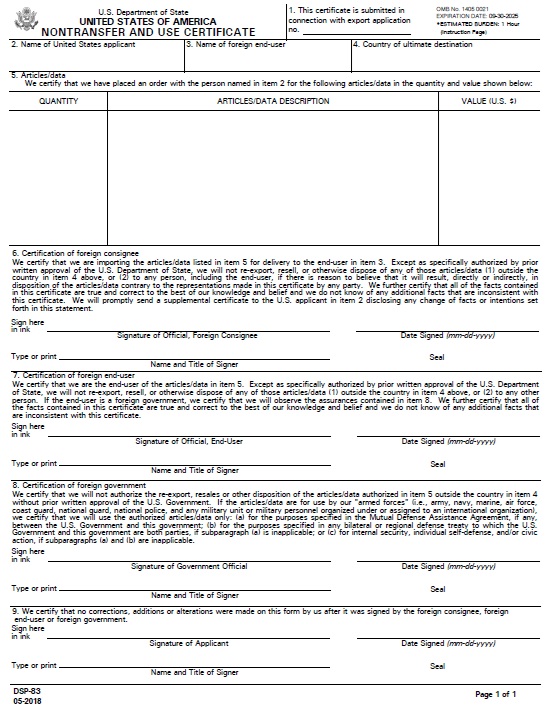
Under current circumstances, it is the policy of the U.S. Government (USG) to require end-use and retransfer assurances for all exports of defense articles to Iraq. For the time being, the applicant need not supply a DSP-83 for cases where the Iraqi Interim Government (IIG) is the proposed end-user.
To legally satisfy the requirements of the Arms Export Control Act and International Traffic in Arms Regulations (ITAR), the IIG has supplied the USG with blanket end-use assurances, which will be used for the near future, without an accompanying DSP-83, for approved exports to the IIG. The application must have a cover letter that explains that the DSP-83 has not been submitted based on this understanding.
For D-Trade submissions, this explanation should be included as a PDF file in lieu of the DSP-83. The USG will officially notify the IIG of all exports to Iraq approved on the basis of such assurances. No further action by the applicant is required. DSP-83s are required for Significant Military Equipment (SME) exports to the Interim Government of Afghanistan.
For coalition forces serving with Operation Iraqi Freedom, a DSP-83 is generally required only for exports of SME. (As with exports to any other destination, DDTC may require a DSP-83 for the export of any defense article or service, at its discretion.) -
For exports to other non-IIG end-users in Iraq (“private” end-users, e.g., international organizations and private contractors), signatures are required on a DSP-83 from the foreign consignee and from the end-user. For the near future, the requirement for the IIG signature on Block 8 of form DSP-83 will be satisfied by the IIG’s blanket assurances. The transmittal letter should also clearly state this.
DDTC has a longstanding policy of not authorizing fully-automatic weapons to private entities, but has made an exception with regard to the activities of private security companies in Iraq/Afghanistan. The preference is for these weapons to be exported temporarily on DSP-73s, although DSP-5s will be considered with appropriate justification.
For fully-automatic firearms proposed for export to a non-IIG (private) end-user in Iraq, DDTC requires:
- justification for the numbers of weapons being requested, with particular attention to follow-on licenses requesting additional quantities;
- end-user assurances using the attached example;
- a letter from the government or international organization responsible for the contract, stating that it will send an inventory report of the fully-automatic weapons to DDTC within five days of the guns’ arrival in Iraq, and account for the ultimate disposition of the weapons upon completion of the mission/termination of the contract.
U.S. companies should pay keen attention to the brokering requirements under Part 129 of the ITAR, and they may not begin such activities until they have the appropriate approvals on registration and licensing in place. Also, all sources should be completely described, including names, locations and addresses.
Gregory M. Suchan Deputy Assistant Secretary
Directorate of Defense Trade Control
U.S. Department of State
2401 E. Street
Washington, DC 20522-0112
RE: End Use and Retransfer Assurances for DSP-5 License Application
Dear Deputy Assistant Secretary Suchan:
I, (Name of Authorizing Company Official, Title, and Company), on behalf of (Name of Company), provide the following assurances to the United States Government. (Name of Company) is performing contract (Number of Contract/Purchase Order) for the (Name of the Contracting Activity, e.g., U.S. Department of the Army, Project and Contracting Office (PCO)), Iraq. In conjunction with the same, (Name of Firm Exporting Commodities), is supplying to (Name of Company), the firearms to perform the aforementioned contract as set forth in (Name of Firm Exporting Commodities) export license application.
(Name of Company) certifies and assures the United States Government that it will comply with the following conditions and end-use and retransfer assurances, as a requirement for (License Number) being issued and for the use of the firearms in Iraq by (Name of Company).
1. Title for the firearms will pass to (Name of Contracting Office or Activity, e.g., the Department of the Army, as represented by the U.S. Army PCO), immediately upon the firearms arriving in Iraq.
2. (Name of Company) will not take possession of the firearms, until the (Responsible Government Activity, e.g., U.S. Army PCO) conducts an inventory of the firearms. A signed and dated copy of the inventory will be provided to the U.S. Department of State, Directorate of Defense Trade Controls.
3. The firearms on the license are for the exclusive use of (Name of Company) personnel performing security duties under the (Applicable Government Contract, e.g., U.S. Army PCO contract) only.
4. No other end-use or retransfer of these articles is allowed without first obtaining written approval from the U.S. Department of State, Directorate of Defense Trade Controls.
5. (Name of Company) will be responsible for maintaining security control and possession of the firearms at all times during the duration of its security duties and will have in place a security program to protect the firearms.
6. During the duration of its contractual duties, (Name of Company) will be responsible to make sure that no party or person involved in security duties who is ineligible to participate in or benefit from U.S. defense trade transactions under United States law or applicable U.S. regulations will gain access to or be in the possession of these firearms.
7. Any loss or destruction of the referenced firearm(s) will be reported immediately in writing by (Name of Company) to: the Interim Iraq Government; American Embassy, Baghdad; the U.S. Department of State, Directorate of Defense Trade Controls; (the Designated Contracting Office or Activity, e.g., U.S. Army PCO); and the U.S. exporter. The report must include type, make, model and serial number of the firearm(s) with explanation of the circumstances surrounding the loss or destruction of the firearm(s), as well as the name, date of birth and citizenship of the last person to have control of the firearm(s).
8. After completion of the contractual duties, (Name of Company) shall transfer all firearms to the Department of the Army, U.S. Army PCO or designated activity. (Name of Company) will provide to the Directorate of Defense Trade Controls a copy of the receipt for the firearms from the Department of the Army, U.S. Army PCO or designated activity. The receipt will contain a complete list of the firearms, with type, make, model and serial number.
Under the penalties of perjury provided by law, I declare that I have examined this document, and to the best of my knowledge and belief, it is true, correct, and complete.
(Authorizing Signature and Title)
§ 123.17
Exports of firearms, ammunition, and body armor. * * * * *
(f) Except as provided in § 126.1 of this subchapter, Port
Directors of U.S. Customs and Border Protection shall permit
U.S. persons to export temporarily from the United States
without a license one set of body armor covered by Category
X
(a)(1) of this subchapter provided that:
(1) A declaration by the U.S. person and an inspection by a
customs officer is made;
(2) The body armor is with the U.S. person's baggage or
effects, whether accompanied or unaccompanied (but not
mailed);
(3) The body armor is for that person's exclusive use and
not for re-export or other transfer of ownership; and
(4) If the body armor is lost or otherwise not returned to
the United States, a detailed report must be submitted to
the Office of Defense Trade Controls Compliance in §
127.12(c)(2) of this subchapter entitled “Voluntary
disclosures.”
(g) The license exemption set forth in paragraph (f) of this
section is also available for the temporary export of body
armor for personal use to Afghanistan and to Iraq provided
that:
(1) The conditions in paragraphs (f)(1)-(f)(3) of this
section are met;
(2) For temporary exports to Iraq the U.S. person utilizing
the license exemption is either a person affiliated with the
U.S. Government traveling on official business or is a
person not affiliated with the U.S. Government but traveling
to Iraq under a direct authorization by the Government of
Iraq and engaging in humanitarian activities for, on behalf
of, or at the request of the Government of Iraq.
|
Special Note for government Security Contractor Operations for the NRC/DoE within NYS -
As of now, the Nuclear Regulatory Commission (NRC) guidelines have not yet been finalized. Accordingly, contractors at NRC licensed facilities are not yet eligible to possess machineguns and ATF could not approve the transfer of machineguns to such contractor. The federal agency can purchase and issue the firearms to the contractor but the firearms remain United States Government property.
You should also note that New York State law generally prohibits the possession of machineguns and BATFE is not aware of an exception that would allow a security contractor to possess. ATF cannot approve an application for transfer where the receipt and possession of the firearm would place the transferee in violation of State law. If and when the NRC guidelines are finalized, BATFE would need confirmation by State authorities that possession under the described circumstances is lawful.
|
 September 13, 2009
http://www.lohud.com/apps/pbcs.dll/article?AID=2009909130338 September 13, 2009
http://www.lohud.com/apps/pbcs.dll/article?AID=2009909130338Nuke plant guards may get machine guns
Greg Clary - gclary@lohud.com
BUCHANAN - Federal regulators are taking steps to allow nuclear plant security guards to carry machine guns and sawed-off shotguns, a step that even some industry opponents support as a way to match the firepower of potential terrorists.
"It's my belief that an upgrade of this kind is long overdue," said Edwin Lyman, a global security expert with the Union of Concerned Scientists in Washington, D.C.
"There's not a ban on semi-automatic weapons anymore, so that's what's out there, not just for terrorists but for the guy on the street," he said. "Security officers need more firepower."
Indian Point officials have not decided if they will add "enhanced weapons," which the Nuclear Regulatory Commission calls the machine guns, short-barreled shotguns or short-barreled rifles, but will review their alternatives when the regulations are finalized.
"With any change in regulations that provide additional options or opportunities, we would look at potential enhancements in our security posture," said Dan Gagnon, security manager at Indian Point. "However, specialized weapons and their potential impact is just one element of a comprehensive security program."
The NRC acknowledges that there hasn't been a single shot fired to defend a nuclear power plant, but the changes were included in the Energy Policy Act of 2005, and the new guidelines have been approved by the U.S. Attorney General, agency officials said. The final regulations could take until 2011 to hammer out.
NRC spokesman Neil Sheehan said the timing of the announcement on the eighth anniversary of Sept. 11 was coincidental.
Lyman said the anniversary of the terrorist attacks was a good time to remember the importance of not underestimating America's enemies.
While the Nuclear Energy Institute, an industry association, supports the weapon upgrades, there are those who think there's more to fear than heavily armed attackers.
"These weapons won't protect us from the spontaneous problems related to the aging of the plant itself, such as steam boiler ruptures, transformer explosions, clogged cooling water intakes or whatever is discovered next," said Manna Jo Greene, environmental director for Hudson River Sloop Clearwater. "Anything that lessens that danger is welcome, but this additional protection does not address the larger issues."
Thomas Locke, a retired FBI agent and private security official in Washington, D.C., said the key to properly handling increased firepower is the person with the gun in his or her hands and the training they have received.
"The bad guys are bringing automatic weapons and explosives, so you have to have something to fight back with," said Locke, who trained nuclear plant guards during an FBI tenure in Tennessee. "The key is vetting the personnel who are going to be assigned these tasks and then training, training and training." Nuclear material cannot be allowed to leave the site, Locke said.
"We talk about casualties all the time, and the emphasis is always on the safety and security of law enforcement personnel," he said. "But there's no room for error with this type of stuff."
Locke said highly trained officers know not to just spray bullets with machine guns; that shorter, more focused bursts of ammunition will be more effective.
With inadequate firepower, however, even sharpshooters can find themselves in trouble.
"We learned a hard lesson back in 1986 in Miami, when two bank robbers with automatic weapons took on FBI agents armed with revolvers and rifles," he said. "We got the robbers, but we lost two agents, and eight others were wounded. You have to have the weapons and you have to know how to use them."
|
|
|
|